TRX Reverse Lunge
Demonstration video

Recommended by our experts
Receive your personalized program
Stop training at random.
Get my program- Program tailored to your profile
- Guided progression
- Compatible with your equipment
- Structured plan
Our coach prepares your program
Get my programHow to do TRX Reverse Lunge
Instructions
- Stand upright facing the anchor point, holding the TRX handles with arms slightly bent.
- Shift your weight onto one leg and step the opposite leg backward into a lunge position.
- Lower your hips, keeping the front knee aligned above the ankle and the back knee just above the ground.
- Push through the front heel to return to the starting standing position, bringing the back leg forward.
- Repeat the movement with the same leg stepping back and returning forward for the entire set, then switch sides.
Technical Tips
- Keep the front knee aligned with your toes at all times.
- Engage your core and glutes to maintain balance throughout the motion.
- Control the movement — avoid letting the rear knee slam into the ground.
- Maintain upright posture with a neutral spine; don’t lean back on the straps.
Breathing Tips
- Inhale as you lower into the reverse lunge.
- Exhale as you push back up to the standing position.
Medical restrictions
- Knee injuries or instability
- Severe balance disorders
- Recent hip or ankle surgery
Description
The TRX Reverse Lunge is a dynamic lower-body movement that utilizes suspension straps to enhance control and balance. In this variation, each repetition involves stepping one leg back into a deep lunge, then returning it fully to the starting position, rather than keeping it in a static stance. This forward-backward motion emphasizes functional coordination, leg power, and joint mobility while maintaining muscular tension throughout the set. The TRX system offers support and helps users maintain optimal posture and balance, making the exercise suitable for a wide range of fitness levels. It is ideal for building unilateral strength, improving symmetry, and training balance in a safe and scalable way.
Frequently asked questions
-
Does the rear leg return forward on every rep in a TRX reverse lunge?
Yes, in a proper TRX reverse lunge, the rear leg returns to the starting position after each repetition, promoting balance and coordination. -
Is the TRX reverse lunge good for beginners?
Yes, the TRX reverse lunge is beginner-friendly and provides assistance with balance and form, making it accessible to most users. -
Which leg works the most in a TRX reverse lunge?
The front leg does most of the work, especially the quadriceps and glutes, while the rear leg helps with balance and movement control. -
How many reps should I do on each leg with TRX reverse lunges?
Perform 8 to 12 reps on one leg, returning the back leg forward each time, then switch sides to ensure balanced development. -
Is stepping back and returning forward important in reverse lunges?
Yes, bringing the leg back to the starting position improves coordination, dynamic balance, and full range of motion engagement.
Variants and alternatives
See all
Runner's lunge
Beginner
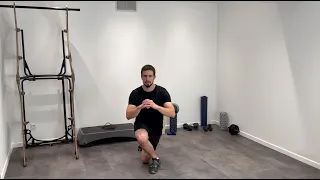
Curtsy lunge
Intermediate

Lunge with thoracic rotation
Beginner
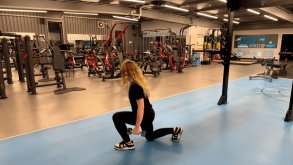
Dumbbell lunge
Intermediate
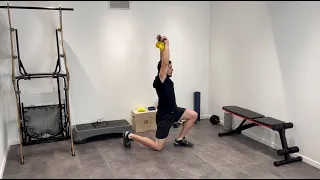
Kettlebell overhead lunge
Advanced
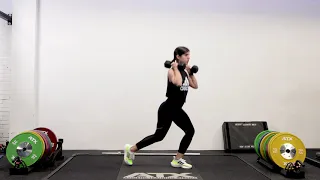
Dumbbell front rack walking lunge
Intermediate
Kettlebell pulse lunge
Intermediate
Trx sprinter start
Intermediate
Alternating lunge with bar
Intermediate
Dumbbell goblet curtsy lunge
Intermediate
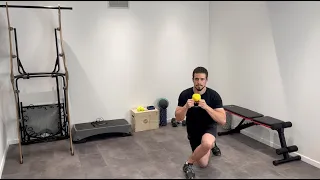
Kettlebell goblet reverse curtsy lunge
Intermediate
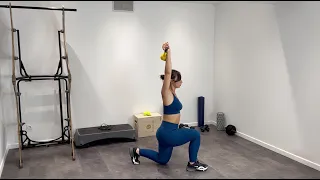
Kettlebell single arm overhead reverse lunge
Advanced
Related fitness articles
See all
Shoulder pain in weight training: prevention and solutions
Risk of injuries

What is the best training structure?
Muscle gain

Lose weight fast: effective and safe methods
Diet

Dietary supplements: what should you know?
Health

Cardio and strength training: how to avoid interference
Weight loss

Supplements taken wrong: mistakes that cancel their effects
Dietary supplements

High-calorie foods: why choose them?
Muscle gain

Mind-muscle connection: the key to effective training
Muscle gain
Recommended by our experts
Receive your personalized program
Stop training at random.
Get my program- Program tailored to your profile
- Guided progression
- Compatible with your equipment
- Structured plan
Our coach prepares your program
Get my program