Cable Kickback
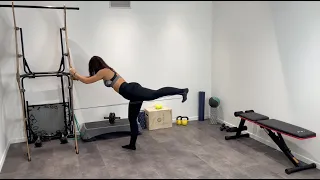
Demonstration video

Recommended by our experts
Receive your personalized program
Stop training at random.
Get my program- Program tailored to your profile
- Guided progression
- Compatible with your equipment
- Structured plan
Our coach prepares your program
Get my programHow to do Cable Kickback
Instructions
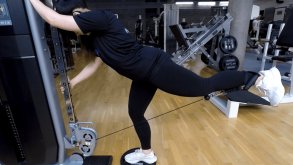
- Attach a single handle to a low cable pulley and hold it with one hand.
- Lean slightly forward at the hips, keeping your back flat and upper arm aligned with your torso.
- With the elbow fixed in place, extend your arm backward until it is fully straightened.
- Pause briefly at full extension, squeezing the triceps.
- Slowly return to the starting position with control.
- Repeat for the desired number of reps, then switch arms if needed.
Technical Tips
- Keep the upper arm stationary throughout the movement.
- Avoid swinging or using momentum.
- Maintain a neutral spine and slight core engagement.
- Use a full range of motion for optimal triceps activation.
Breathing Tips
- Exhale as you extend your arm back.
- Inhale as you return to the starting position.
Medical restrictions
- Avoid if experiencing elbow tendonitis or triceps strain.
- Not recommended for individuals with recent shoulder injuries.
- Consult a professional if you have restricted shoulder mobility.
Description
The Cable Kickback is a targeted isolation exercise for the triceps, ideal for enhancing arm definition and upper-body strength. Utilizing a cable machine provides constant resistance, helping to maximize muscle engagement throughout the entire range of motion. This exercise is especially effective in developing the long head of the triceps, contributing to overall arm mass and aesthetics. By keeping the upper arm fixed and extending the forearm backward, the movement isolates the triceps while minimizing shoulder involvement. It's an excellent choice for those looking to improve arm tone, push strength, and muscular balance in upper body routines. Suitable for intermediate users, it can be integrated into strength-building or hypertrophy-focused training sessions. The cable mechanism allows for precise load control, making it both effective and joint-friendly when executed with proper form.
Frequently asked questions
-
What muscles do cable triceps kickbacks target?
Cable triceps kickbacks primarily target the triceps brachii, especially the long head, and help in building arm strength and definition. -
Are cable kickbacks better than dumbbell kickbacks?
Cable kickbacks offer constant tension throughout the movement, which can lead to better muscle activation compared to dumbbells, especially during the eccentric phase. -
How do I avoid using my shoulder during cable triceps kickbacks?
Keep your upper arm stationary and parallel to your torso, only moving the forearm by extending the elbow to isolate the triceps effectively. -
How many sets and reps should I do for triceps with cable kickbacks?
For muscle growth, aim for 3 to 4 sets of 10 to 15 reps, focusing on form and triceps contraction during each repetition. -
Is the cable kickback suitable for women wanting toned arms?
Yes, the cable kickback is excellent for toning and defining the triceps, making it a valuable exercise for anyone aiming for lean, sculpted arms.

Related fitness articles
See all
Shoulder pain in weight training: prevention and solutions
Risk of injuries

What is the best training structure?
Muscle gain

Lose weight fast: effective and safe methods
Diet

Dietary supplements: what should you know?
Health

Cardio and strength training: how to avoid interference
Weight loss

Supplements taken wrong: mistakes that cancel their effects
Dietary supplements

High-calorie foods: why choose them?
Muscle gain
Mind-muscle connection: the key to effective training
Muscle gain
Recommended by our experts
Receive your personalized program
Stop training at random.
Get my program- Program tailored to your profile
- Guided progression
- Compatible with your equipment
- Structured plan
Our coach prepares your program
Get my program