Box Jump
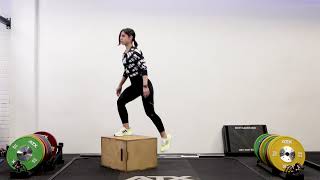
Demonstration video
Recommended by our experts
Receive your personalized program
Stop training at random.
Get my program- Program tailored to your profile
- Guided progression
- Compatible with your equipment
- Structured plan
Our coach prepares your program
Get my programHow to do Box Jump
Instructions
- Stand in front of the plyo box with feet shoulder-width apart.
- Bend your knees and swing your arms backward to prepare for the jump.
- Explosively jump onto the box, landing softly with both feet flat.
- Stand fully upright on the box to complete the repetition.
- Step down carefully to return to the starting position.
Technical Tips
- Engage your core before jumping to stabilize your trunk.
- Land with your knees slightly bent to absorb impact.
- Keep your chest up and back straight throughout the movement.
Breathing Tips
- Inhale before initiating the jump.
- Exhale explosively as you push off the ground.
- Inhale again as you stabilize on top of the box.
Medical restrictions
- Knee injuries
- Ankle instability
- Severe lower back pain
- Poor balance or coordination
Description
The Box Jump is a high-intensity plyometric exercise designed to develop lower-body power, coordination, and explosive strength. Performed by jumping from the ground onto a raised platform such as a plyo box, this movement primarily targets the glutes and quadriceps, making it an excellent addition to lower-body strength and athletic performance routines. Ideal for athletes, functional fitness enthusiasts, and anyone seeking to enhance explosive power, the Box Jump also contributes to improved cardiovascular endurance and overall agility. Due to its ballistic nature, it helps in training fast-twitch muscle fibers, crucial for sprinting and jumping activities. It is especially effective in HIIT or CrossFit settings where speed and intensity matter. This versatile exercise requires minimal equipment and space, making it suitable for both gym and home environments. Box Jumps are scalable by adjusting the box height, allowing for progressive overload and continued gains in performance. When executed with proper form, they also promote better landing mechanics, reducing the risk of injury in sport-specific scenarios.
Frequently asked questions
-
What muscles do box jumps work the most?
Box jumps primarily target the glutes and quadriceps, helping to build explosive power and strength in the lower body. -
Are box jumps good for weight loss?
Yes, box jumps are a high-intensity, calorie-burning exercise that supports fat loss and cardiovascular conditioning when included in a consistent workout routine. -
How high should the box be for box jumps?
Beginners should start with a box height of 12–18 inches, while advanced users may progress to 24–30 inches based on strength and skill level. -
Are box jumps safe for the knees?
Box jumps are safe for healthy knees when performed with proper technique, but individuals with knee pain or injuries should consult a medical professional before attempting them. -
How many box jumps should I do in a workout?
Start with 3–4 sets of 5–10 reps, focusing on quality and explosiveness over volume to reduce fatigue-related form breakdown.

Related fitness articles
See all
Shoulder pain in weight training: prevention and solutions
Risk of injuries

What is the best training structure?
Muscle gain

Lose weight fast: effective and safe methods
Diet

Dietary supplements: what should you know?
Health

Cardio and strength training: how to avoid interference
Weight loss

Supplements taken wrong: mistakes that cancel their effects
Dietary supplements

High-calorie foods: why choose them?
Muscle gain

Mind-muscle connection: the key to effective training
Muscle gain
Recommended by our experts
Receive your personalized program
Stop training at random.
Get my program- Program tailored to your profile
- Guided progression
- Compatible with your equipment
- Structured plan
Our coach prepares your program
Get my program