Kettlebell Long Lever Skullcrusher
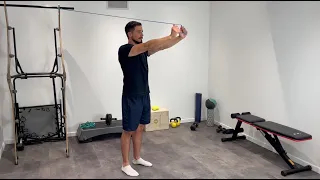
Demonstration video

Recommended by our experts
Receive your personalized program
Stop training at random.
Get my program- Program tailored to your profile
- Guided progression
- Compatible with your equipment
- Structured plan
Our coach prepares your program
Get my programHow to do Kettlebell Long Lever Skullcrusher
Instructions
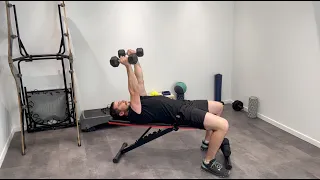
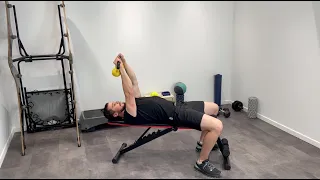
- Lie flat on a musculation bench with feet firmly planted on the floor.
- Hold a kettlebell in each hand with arms fully extended above your chest, palms facing each other.
- Keeping your elbows stationary, slowly bend your arms to lower the kettlebells toward your forehead.
- Stop when the kettlebells are close to your head or just past 90 degrees at the elbows.
- Contract your triceps to extend the arms back to the starting position.
Technical Tips
- Keep elbows fixed and close to your head throughout the movement.
- Avoid flaring your elbows to reduce shoulder strain.
- Use a slow and controlled tempo, especially during the eccentric phase.
- Do not let the kettlebells drift behind the head—keep the motion vertical.
Breathing Tips
- Inhale as you lower the kettlebells toward your forehead.
- Exhale as you extend your arms back to the top position.
Medical restrictions
- Elbow tendinitis or joint pain
- Shoulder impingement or instability
- Wrist mobility limitations
Description
The Kettlebell Long Lever Skullcrusher is an effective isolation exercise targeting the triceps, particularly the long head, by utilizing a longer lever arm with kettlebells for increased resistance. Performed on a flat bench, this variation emphasizes control and stability, challenging the triceps more intensely compared to traditional skullcrusher variations. The use of kettlebells introduces an unstable load, promoting greater neuromuscular coordination and joint stabilization. Ideal for intermediate lifters, this exercise helps in developing arm size, enhancing lockout strength, and improving overhead pressing performance. It is especially useful in hypertrophy and accessory training phases for bodybuilding, fitness, or functional strength programs. This movement not only builds muscular endurance but also enhances control in elbow extension patterns, contributing to balanced upper body development.
Frequently asked questions
-
How do I do kettlebell long lever skullcrushers correctly?
To perform kettlebell long lever skullcrushers correctly, lie on a bench with a kettlebell in each hand, lower them toward your forehead by bending at the elbows, then extend your arms back up while keeping elbows fixed in place. -
What muscles do kettlebell long lever skullcrushers work?
Kettlebell long lever skullcrushers primarily work the triceps, with emphasis on the long head, and also engage the forearm flexors and extensors for grip and stabilization. -
Are kettlebell skullcrushers better than dumbbell skullcrushers?
Kettlebell skullcrushers provide more instability and require greater control, making them better for improving triceps activation and joint stability, while dumbbells offer a more traditional, stable resistance path. -
Can beginners do kettlebell long lever skullcrushers?
While not ideal for absolute beginners due to stability demands, kettlebell long lever skullcrushers can be performed by those with basic triceps training experience and proper elbow control. -
What weight should I use for kettlebell long lever skullcrushers?
Start with light to moderate kettlebells that allow full control and correct form, then progressively increase as strength and stability improve.
Related fitness articles
See all
Shoulder pain in weight training: prevention and solutions
Risk of injuries

What is the best training structure?
Muscle gain

Lose weight fast: effective and safe methods
Diet

Dietary supplements: what should you know?
Health

Cardio and strength training: how to avoid interference
Weight loss

Supplements taken wrong: mistakes that cancel their effects
Dietary supplements

High-calorie foods: why choose them?
Muscle gain

Mind-muscle connection: the key to effective training
Muscle gain
Recommended by our experts
Receive your personalized program
Stop training at random.
Get my program- Program tailored to your profile
- Guided progression
- Compatible with your equipment
- Structured plan
Our coach prepares your program
Get my program