Psoas March
Demonstration video
Recommended by our experts
Receive your personalized program
Stop training at random.
Get my program- Program tailored to your profile
- Guided progression
- Compatible with your equipment
- Structured plan
Our coach prepares your program
Get my programHow to do Psoas March
Instructions
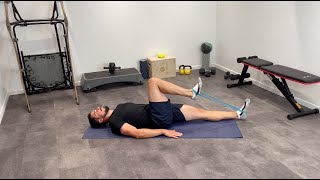
- Lie flat on your back with knees bent at 90 degrees and resistance band looped around both feet.
- Engage your core and press your lower back into the floor.
- Slowly extend one leg forward while keeping the opposite knee stable.
- Return to the start position and repeat on the other side.
- Continue alternating legs in a controlled marching motion.
Technical Tips
- Keep your core braced throughout the movement.
- Avoid arching your lower back when extending the leg.
- Maintain steady control to prevent momentum from taking over.
Breathing Tips
- Inhale before initiating the movement.
- Exhale as you extend the leg forward.
- Inhale again as you return to the starting position.
Medical restrictions
- Avoid if experiencing acute lower back pain or lumbar instability.
- Not recommended for individuals with hip flexor strain or tightness.
- Consult a physician if recovering from abdominal surgery.
Description
The Psoas March is a foundational core stability exercise that targets deep hip flexors, especially the psoas muscle. Performed on the floor with or without resistance bands, it strengthens the connection between the lower back, pelvis, and abdominal wall. This movement mimics a walking motion while isolating each side of the core, making it ideal for improving balance, posture, and pelvic control. Common in rehabilitation and functional fitness routines, the Psoas March promotes proper activation of the stabilizing muscles that support efficient movement and reduce risk of injury. Its low-impact nature makes it suitable for beginners, as well as for those looking to reinforce their core prior to advancing into more complex compound movements.
Frequently asked questions
-
What muscles does the Psoas March target?
The Psoas March primarily targets the abs, specifically the deep hip flexors like the psoas, and also engages the obliques, quads, and glutes for stabilization. -
Is the Psoas March good for lower back pain?
Yes, when performed correctly, the Psoas March can help improve core stability and reduce strain on the lower back, making it beneficial for managing and preventing lower back pain. -
Do I need equipment to do the Psoas March?
The Psoas March can be done without equipment, but using a resistance band adds intensity and increases the challenge for the core and hip flexors. -
How many reps of Psoas March should I do?
For beginners, 2–3 sets of 10–12 reps per side is effective. Focus on control and form rather than speed or high repetitions. -
Can I include the Psoas March in my warm-up routine?
Yes, it's an excellent addition to a warm-up routine as it activates the core and hip flexors, preparing the body for more dynamic movement.
Variants and alternatives
See all

Related fitness articles
See all
Shoulder pain in weight training: prevention and solutions
Risk of injuries

What is the best training structure?
Muscle gain

Lose weight fast: effective and safe methods
Diet

Dietary supplements: what should you know?
Health

Cardio and strength training: how to avoid interference
Weight loss

Supplements taken wrong: mistakes that cancel their effects
Dietary supplements

High-calorie foods: why choose them?
Muscle gain
Mind-muscle connection: the key to effective training
Muscle gain
Recommended by our experts
Receive your personalized program
Stop training at random.
Get my program- Program tailored to your profile
- Guided progression
- Compatible with your equipment
- Structured plan
Our coach prepares your program
Get my program