TRX Split Squat
Demonstration video

Recommended by our experts
Receive your personalized program
Stop training at random.
Get my program- Program tailored to your profile
- Guided progression
- Compatible with your equipment
- Structured plan
Our coach prepares your program
Get my programHow to do TRX Split Squat
Instructions
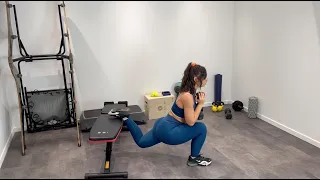
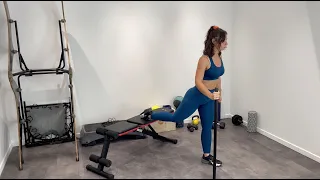
- Adjust the TRX straps to mid-length and stand facing away from the anchor point.
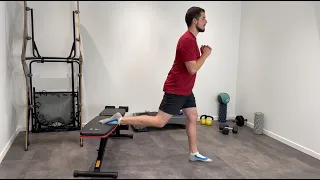
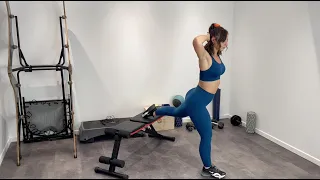
- Place one foot in the TRX handle behind you and keep the other foot flat on the ground in front.
- Maintain an upright torso and engage your core.
- Lower your body by bending the front knee, keeping the knee aligned with the ankle.
- Descend until the back knee is just above the ground, then push through the front heel to return to start.
- Repeat all reps on one leg before switching sides.
Technical Tips
- Keep the front knee tracking over the toes without letting it cave inward.
- Avoid leaning forward—maintain an upright posture throughout.
- Engage your core and glutes to stabilize the movement.
Breathing Tips
- Inhale as you lower into the squat.
- Exhale as you push back up to the starting position.
Medical restrictions
- Knee injuries
- Hip instability
- Ankle mobility limitations
- Balance disorders
Description
The TRX Split Squat is a powerful lower-body exercise that enhances leg strength, balance, and coordination using a suspension training system. This unilateral movement focuses on the quadriceps and glutes while engaging the core for stability and alignment. Unlike traditional squats, the split squat format places one leg behind you in a suspended position, requiring increased neuromuscular control and proprioception. The instability created by the TRX straps forces deeper muscle engagement, especially in the gluteus medius and hamstrings, contributing to better joint health and overall lower-limb function. Ideal for athletes, fitness enthusiasts, and rehabilitation settings, the TRX Split Squat offers a scalable challenge that improves functional strength and mobility. It's particularly effective for addressing muscle imbalances between the legs and enhancing single-leg performance. This exercise is a staple in functional training programs and is highly effective for developing lower-body strength without the need for heavy weights.
Frequently asked questions
-
What muscles does the TRX Split Squat work?
The TRX Split Squat primarily targets the quadriceps and glutes, while also engaging the hamstrings, adductors, calves, and core for stability. -
Is the TRX Split Squat good for building leg strength?
Yes, the TRX Split Squat is excellent for building leg strength, especially in the quadriceps and glutes, while also improving balance and coordination. -
Can beginners perform the TRX Split Squat?
Beginners can perform the TRX Split Squat by starting with a shorter range of motion and holding onto a support for additional balance until confident. -
How is the TRX Split Squat different from a Bulgarian Split Squat?
The TRX Split Squat uses suspension straps to support the rear foot, adding instability and requiring more core activation than the Bulgarian Split Squat. -
How many reps should I do for TRX Split Squats?
Aim for 8–12 reps per leg for strength training, or 12–15 reps per leg for endurance and functional conditioning.
Related fitness articles
See all
Shoulder pain in weight training: prevention and solutions
Risk of injuries

What is the best training structure?
Muscle gain

Lose weight fast: effective and safe methods
Diet

Dietary supplements: what should you know?
Health

Cardio and strength training: how to avoid interference
Weight loss

Supplements taken wrong: mistakes that cancel their effects
Dietary supplements

High-calorie foods: why choose them?
Muscle gain
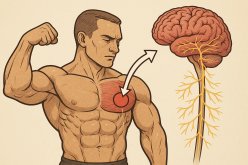
Mind-muscle connection: the key to effective training
Muscle gain
Recommended by our experts
Receive your personalized program
Stop training at random.
Get my program- Program tailored to your profile
- Guided progression
- Compatible with your equipment
- Structured plan
Our coach prepares your program
Get my program