Stork Stretch with Twist
Demonstration video
Recommended by our experts
Receive your personalized program
Stop training at random.
Get my program- Program tailored to your profile
- Guided progression
- Compatible with your equipment
- Structured plan
Our coach prepares your program
Get my programHow to do Stork Stretch with Twist
Instructions
- Stand with feet hip-width apart and arms relaxed.
- Inhale and keep the spine long.
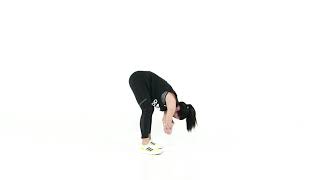
- Exhale and hinge forward at the hips, lowering the torso.
- Cross your arms, holding opposite elbows, and let your upper body hang.
- Gently rotate the torso to one side, allowing one elbow to move closer to the floor.
- Hold briefly, return to center, then rotate to the opposite side.
- Slowly roll up through the spine to return to standing.
Technical tips
- Rotate gently, avoid forcing the twist.
- Keep the core engaged to protect the lower back.
- Relax the neck and shoulders during the fold.
- Shift weight evenly across both feet.
Breathing tips
- Inhale deeply before folding.
- Exhale while hinging forward and twisting.
- Breathe steadily while holding each side rotation.
- Inhale as you return to standing.
Medical restrictions
- Avoid if you have herniated discs or severe spinal issues.
- Not recommended for acute hamstring or lower back injuries.
- Consult a doctor if you have vertigo or uncontrolled high blood pressure.
Description
The Stork Stretch with Twist, also known as the Twisted Forward Fold or Parivrtta Uttanasana, combines the benefits of a forward bend with gentle spinal rotation. From a folded position, the arms are crossed while the torso rotates alternately to the left and right. This variation stretches the hamstrings and lower back while adding mobility to the spine and activation of the oblique muscles. The twisting element also stimulates the abdominal region, supporting digestion and core engagement. Unlike the standard forward bend, this exercise introduces a dynamic rotational component that challenges balance and flexibility simultaneously. The Stork Stretch with Twist is often included in yoga, fitness, and mobility routines to improve spinal health, release muscular tension, and enhance posture. It can be practiced as part of a warm-up, cool-down, or recovery sequence. By encouraging both elongation and rotation, this exercise offers a comprehensive stretch for the back body while promoting relaxation and functional mobility.
Frequently asked questions
-
What muscles does the Stork Stretch with Twist work?
It primarily stretches the hamstrings and back while also engaging the obliques, lower back, glutes, and calves. -
What are the benefits of adding the twist?
The twist increases spinal mobility, engages the core, and enhances balance while still stretching the hamstrings and back. -
What is the most common mistake in this exercise?
The most common mistake is forcing the rotation instead of allowing a natural, gentle twist supported by the breath. -
Is the Stork Stretch with Twist safe for the lower back?
Yes, it is safe when performed with controlled movement and core engagement, but it should be avoided by those with serious spinal injuries. -
How is this variation different from the standard Stork Stretch?
The twist variation adds spinal rotation and oblique activation, while the standard version focuses mainly on hamstring and back flexibility. -
How long should I hold the twist on each side?
Hold each side for 10 to 20 seconds, breathing deeply, before rotating to the other side.
Related fitness articles
See all
Shoulder pain in weight training: prevention and solutions
Risk of injuries
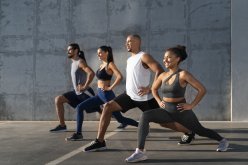
What is the best training structure?
Muscle gain

Lose weight fast: effective and safe methods
Diet

Dietary supplements: what should you know?
Health

Cardio and strength training: how to avoid interference
Weight loss
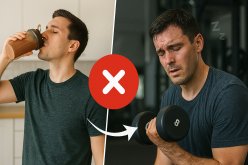
Supplements taken wrong: mistakes that cancel their effects
Dietary supplements
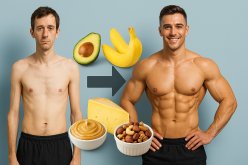
High-calorie foods: why choose them?
Muscle gain
Mind-muscle connection: the key to effective training
Muscle gain
Recommended by our experts
Receive your personalized program
Stop training at random.
Get my program- Program tailored to your profile
- Guided progression
- Compatible with your equipment
- Structured plan
Our coach prepares your program
Get my program