Banded Single-Leg Glute Bridge
Demonstration video

Recommended by our experts
Receive your personalized program
Stop training at random.
Get my program- Program tailored to your profile
- Guided progression
- Compatible with your equipment
- Structured plan
Our coach prepares your program
Get my programHow to do Banded Single-Leg Glute Bridge
Instructions
- Lie on your back on a yoga mat with knees bent and one foot flat on the floor.
- Loop a resistance band over your hips and secure it with a dumbbell.
- Extend the opposite leg straight out in line with your torso.
- Drive through the heel of your planted foot and lift your hips until your body forms a straight line from shoulders to knee.
- Pause at the top, squeezing your glutes, then lower slowly back to the ground.
- Repeat for the desired number of reps before switching legs.
Technical Tips
- Keep your core engaged to avoid arching your lower back.
- Ensure hips stay level throughout the movement.
- Focus on driving through the heel, not the toes.
- Use a moderate resistance band to maintain control.
Breathing Tips
- Inhale as you prepare at the bottom.
- Exhale during the lift as you thrust your hips upward.
- Inhale again while lowering your hips back down.
Medical restrictions
- Lower back pain or injury
- Hip impingement
- Post-surgical knee conditions
Description
The Banded One-Leg Glute Bridge is a targeted lower-body exercise designed to isolate and strengthen the glute muscles, particularly the gluteus maximus and gluteus medius. This variation introduces a resistance band to increase tension throughout the movement, enhancing muscle activation and building unilateral strength. It also challenges stability, balance, and core control, making it highly effective for correcting muscular imbalances and improving functional movement. Ideal for intermediate exercisers, this bodyweight-based movement is commonly used in strength training, injury prevention, and athletic conditioning programs. Requiring only minimal equipment—a yoga mat, elastic band, and dumbbell—this glute bridge variation can be performed virtually anywhere. It is especially beneficial for those seeking to develop stronger, more defined glutes while reducing strain on the lower back. Additionally, it promotes pelvic stability and helps in reinforcing hip alignment. Regularly incorporating this exercise into your routine can enhance posture, boost athletic performance, and support overall lower-body health.
Frequently asked questions
-
What muscles does the banded single-leg glute bridge target?
The banded single-leg glute bridge primarily targets the gluteus maximus while also engaging the gluteus medius, hamstrings, and core muscles for stability and control. -
Is the banded one-leg glute bridge good for building glutes?
Yes, the banded one-leg glute bridge is highly effective for glute development due to its isolation of the working side and the added resistance from the band, increasing muscle activation. -
Can I do the banded glute bridge at home?
Absolutely, the banded glute bridge can be performed at home using a resistance band, a yoga mat, and a dumbbell to secure the band—no machines or gym access required. -
How many reps should I do for each leg?
Aim for 8–15 controlled reps per leg depending on your fitness level and the resistance used. Focus on quality of movement over quantity. -
Why use a resistance band during glute bridges?
Using a resistance band increases tension throughout the range of motion, improves glute engagement, and challenges your muscles more effectively than bodyweight alone.
Variants and alternatives
See all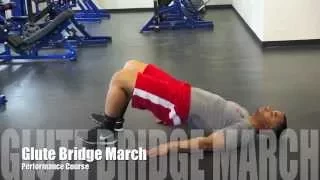
Glute bridge march
Beginner
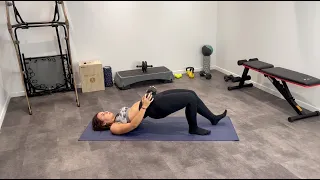
Dumbbell staggered glute bridge
Intermediate
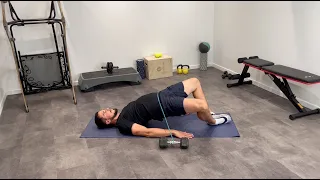
Banded frog pumps
Beginner
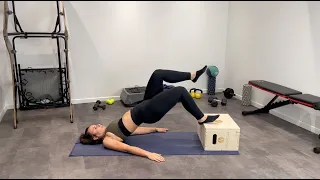
Feet elevated single leg glute bridge
Intermediate
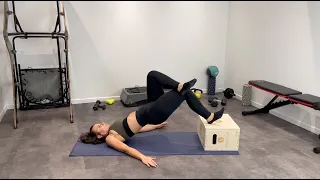
Feet elevated figure four glute bridge
Intermediate
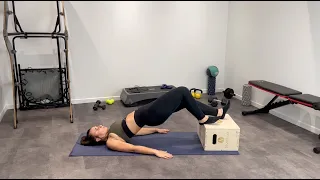
Feet elevated staggered glute bridge
Intermediate
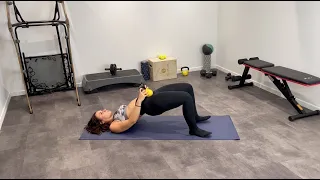
Kettlebell glute bridge
Beginner
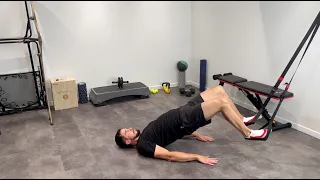
Trx glute bridge
Intermediate
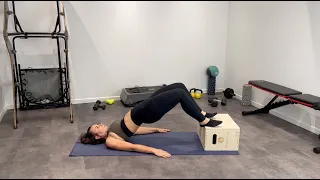
Feet elevated glute bridge
Intermediate
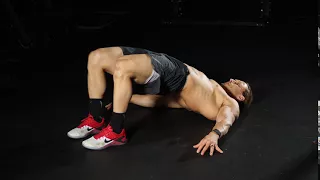
Glute bridge hold
Beginner
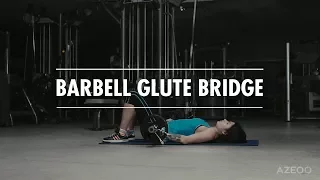
Barbell glute bridge
Beginner
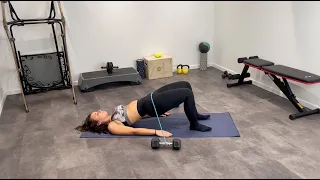
Banded glute bridge hold
Beginner
Related fitness articles
See all
Shoulder pain in weight training: prevention and solutions
Risk of injuries
What is the best training structure?
Muscle gain

Lose weight fast: effective and safe methods
Diet

Dietary supplements: what should you know?
Health

Cardio and strength training: how to avoid interference
Weight loss
Supplements taken wrong: mistakes that cancel their effects
Dietary supplements

High-calorie foods: why choose them?
Muscle gain
Mind-muscle connection: the key to effective training
Muscle gain
Recommended by our experts
Receive your personalized program
Stop training at random.
Get my program- Program tailored to your profile
- Guided progression
- Compatible with your equipment
- Structured plan
Our coach prepares your program
Get my program