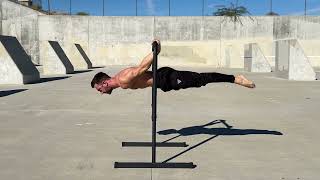
Back lever
Demonstration video
Recommended by our experts
Receive your personalized program
Stop training at random.
Get my program- Program tailored to your profile
- Guided progression
- Compatible with your equipment
- Structured plan
Our coach prepares your program
Get my programHow to do Back lever
Instructions
- Grip the bar with hands shoulder-width apart.
- Engage your core and slowly rotate backward into an inverted hang.
- Lower your body until fully extended horizontally, facing down.
- Hold the position with a straight body line.
- Exit safely by tucking knees and returning to hang.
Technical tips
- Keep arms straight and locked.
- Engage lats and core to maintain horizontal alignment.
- Do not arch or bend your lower back.
- Control the movement slowly to avoid swinging.
Breathing tips
- Inhale deeply before lowering into position.
- Hold breath lightly to stabilize during the isometric hold.
- Exhale slowly when exiting the position.
Medical restrictions
- Shoulder injuries
- Elbow injuries
- Lower back pain
- Wrist pain
Description
The back lever is an advanced calisthenics and gymnastics exercise that demonstrates a high level of body control, strength, and stability. It involves holding the body parallel to the ground while suspended face-down from a horizontal bar. This static hold requires significant engagement of the core, shoulders, and back muscles to maintain a straight and rigid body line. Practicing the back lever helps improve total-body tension, enhances balance, and develops joint stability, particularly in the shoulders and elbows.
The back lever is not only a strength-based exercise but also a skill that tests body awareness and discipline. Athletes often use it to build a foundation for more complex static holds and to complement dynamic pulling or pushing movements. In addition to its role in gymnastics and calisthenics, the back lever can also benefit athletes in other sports by improving posture, core stability, and overall muscular endurance.
Because of its difficulty, the back lever should be approached progressively, using easier progressions such as the tuck back lever or straddle back lever before attempting the full version. With consistent practice and proper technique, this exercise serves as an excellent benchmark of upper body and core strength, while also highlighting the importance of controlled movement and structural alignment.
Frequently asked questions
-
What muscles does the back lever work?
The back lever primarily works the core, back, and shoulders, with secondary activation in the arms, glutes, and legs for stability and control. -
Is the back lever good for core strength?
Yes, the back lever is highly effective for building core strength as it requires intense engagement of the abs and lower back to maintain a straight body line. -
How long should I hold a back lever?
Beginners may start with holds of just a few seconds, while advanced athletes aim for 10–20 seconds of strict form to maximize strength and stability benefits. -
Do I need to master the front lever before learning the back lever?
No, the front lever and back lever are separate skills, but training them together can improve balance and overall body control. -
Is the back lever safe for beginners?
The back lever is an advanced exercise and not recommended for beginners without prior strength and mobility preparation. Progressions should be mastered first to avoid injury.
Related fitness articles
See all
Shoulder pain in weight training: prevention and solutions
Risk of injuries
What is the best training structure?
Muscle gain

Lose weight fast: effective and safe methods
Diet

Dietary supplements: what should you know?
Health

Cardio and strength training: how to avoid interference
Weight loss
Supplements taken wrong: mistakes that cancel their effects
Dietary supplements

High-calorie foods: why choose them?
Muscle gain
Mind-muscle connection: the key to effective training
Muscle gain
Recommended by our experts
Receive your personalized program
Stop training at random.
Get my program- Program tailored to your profile
- Guided progression
- Compatible with your equipment
- Structured plan
Our coach prepares your program
Get my program