Wide-Grip Lat Pulldown
Demonstration video
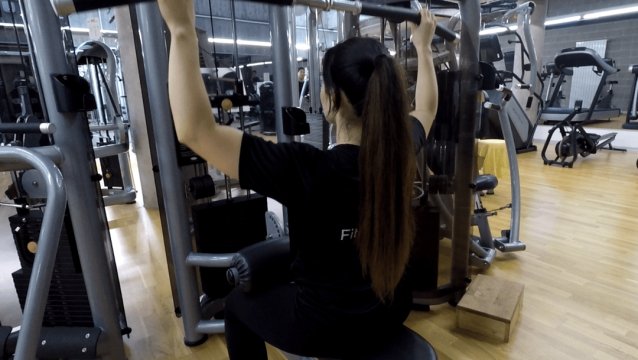
Recommended by our experts
Receive your personalized program
Stop training at random.
Get my program- Program tailored to your profile
- Guided progression
- Compatible with your equipment
- Structured plan
Our coach prepares your program
Get my programHow to do Wide-Grip Lat Pulldown
Instructions
- Sit down on the machine and adjust the thigh pads to secure your legs.
- Grip the wide bar with your hands positioned wider than shoulder-width, palms facing forward.
- Start with your arms fully extended and your torso upright.
- Pull the bar down towards your upper chest, leading with your elbows and squeezing your shoulder blades.
- Pause briefly at the bottom of the movement.
- Slowly return the bar to the starting position with controlled motion.
Technical Tips
- Avoid using momentum or swinging your torso.
- Keep your chest up and core engaged throughout the movement.
- Do not let the bar travel behind your neck to prevent shoulder strain.
- Focus on driving the elbows downward rather than pulling with the arms.
Breathing Tips
- Exhale as you pull the bar down.
- Inhale as you return to the starting position.
Medical restrictions
- Avoid if you have shoulder impingement or rotator cuff injuries.
- Use caution if you have a history of lower back pain; maintain proper posture.
Description
The wide-grip lat pulldown is a foundational strength training exercise designed to build width and definition in the upper back. By using a wider hand placement, this variation emphasizes the latissimus dorsi while also recruiting supporting muscles such as the rhomboids and rear deltoids. It is commonly performed on a guided machine, which allows controlled resistance and reduced injury risk, making it suitable for beginners and experienced lifters alike. This exercise mimics the pulling motion of a pull-up, making it an ideal alternative for those developing upper-body strength. Regular inclusion of the wide-grip lat pulldown in a training program enhances back symmetry, posture, and overall pulling power—critical components for both aesthetic goals and athletic performance. Because of its isolated targeting of the back and ease of execution, it remains a staple in bodybuilding and general fitness routines.
Credits
Frequently asked questions
-
What muscles do wide-grip lat pulldowns target?
Wide-grip lat pulldowns primarily target the latissimus dorsi muscles in the back, while also engaging the rhomboids, biceps, and rear deltoids to a lesser extent. -
Is the wide-grip lat pulldown good for beginners?
Yes, it is beginner-friendly due to the guided motion of the machine, which helps control form and reduce injury risk while building back strength. -
Should I pull the bar behind my neck or to the front?
Always pull the bar to the front, towards your upper chest, to minimize shoulder strain and maintain safe biomechanics. -
How wide should my grip be for a wide-grip pulldown?
Your grip should be wider than shoulder-width, typically positioned at the outer bends of the bar to effectively target the lats.
Variants and alternatives
See all
Related fitness articles
See all
Shoulder pain in weight training: prevention and solutions
Risk of injuries

What is the best training structure?
Muscle gain

Lose weight fast: effective and safe methods
Diet

Dietary supplements: what should you know?
Health

Cardio and strength training: how to avoid interference
Weight loss

Supplements taken wrong: mistakes that cancel their effects
Dietary supplements

High-calorie foods: why choose them?
Muscle gain

Mind-muscle connection: the key to effective training
Muscle gain
Recommended by our experts
Receive your personalized program
Stop training at random.
Get my program- Program tailored to your profile
- Guided progression
- Compatible with your equipment
- Structured plan
Our coach prepares your program
Get my program