Weighted Pull Up
Demonstration video
Recommended by our experts
Receive your personalized program
Stop training at random.
Get my program- Program tailored to your profile
- Guided progression
- Compatible with your equipment
- Structured plan
Our coach prepares your program
Get my programHow to do Weighted Pull Up
Instructions
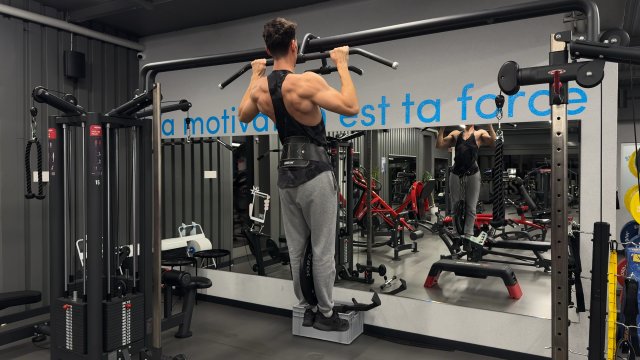
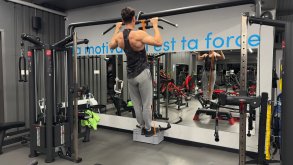
- Attach weight securely to a dip belt around your waist.
- Grip the pull-up bar with hands slightly wider than shoulder-width, palms facing forward.
- Hang with arms fully extended and core engaged.
- Pull your body upward until your chin clears the bar.
- Lower yourself back down under control to full arm extension.
- Repeat for the desired number of repetitions.
Technical tips
- Avoid swinging or kipping; keep the movement strict.
- Engage your lats by pulling your elbows down and back.
- Keep your core tight to prevent excessive arching.
- Choose an appropriate weight that allows controlled reps.
Breathing tips
- Inhale deeply at the bottom hang position.
- Exhale as you pull your body upward.
- Inhale again while lowering back down slowly.
Medical restrictions
- Shoulder impingement or instability
- Elbow tendinitis
- Lower back injury
- Recent wrist or forearm injury
Description
The weighted pull up is an advanced strength exercise designed to increase upper body power, muscle mass, and pulling strength by adding external resistance to the traditional pull up. Using a kettlebell attached to a dip belt, this variation challenges the back and biceps while demanding greater core stabilization. Because the exercise involves lifting a significant portion of bodyweight plus additional load, it is highly effective for building latissimus dorsi thickness, biceps strength, and grip endurance. Weighted pull ups are commonly used in bodybuilding, calisthenics, CrossFit, and athletic performance training to improve pull-up capacity, enhance pulling mechanics, and prepare for advanced movements such as muscle-ups. By progressively overloading the pull up, lifters can break through plateaus and stimulate new muscle growth. Beyond aesthetic benefits, this exercise also develops functional pulling strength useful for climbing, grappling, and sports requiring upper body power. As a compound movement, weighted pull ups recruit multiple joints and muscle groups, making them efficient for overall strength development. They should be performed with strict form, controlled tempo, and appropriate load selection to minimize injury risk while maximizing performance outcomes.
Credits

Frequently asked questions
-
What muscles do weighted pull ups work?
Weighted pull ups primarily target the back and biceps, with strong activation of the lats, rhomboids, traps, forearms, and core stabilizers. -
What are the benefits of doing weighted pull ups?
Weighted pull ups build back and biceps strength, improve grip endurance, increase muscle mass, and enhance overall pulling power for sports and functional fitness. -
What is the most common mistake in weighted pull ups?
The most common mistake is using momentum or kipping instead of controlled pulling, which reduces effectiveness and increases injury risk. -
Are weighted pull ups safe for shoulders?
Weighted pull ups are safe for healthy shoulders if performed with proper form, full range of motion, and progressive loading. Individuals with shoulder injuries should use caution or avoid them. -
How do weighted pull ups compare to regular pull ups?
Weighted pull ups increase resistance and strength gains beyond bodyweight pull ups, but they require more stability, proper form, and recovery.

Related fitness articles
See all
Shoulder pain in weight training: prevention and solutions
Risk of injuries

What is the best training structure?
Muscle gain

Lose weight fast: effective and safe methods
Diet

Dietary supplements: what should you know?
Health

Cardio and strength training: how to avoid interference
Weight loss
Supplements taken wrong: mistakes that cancel their effects
Dietary supplements

High-calorie foods: why choose them?
Muscle gain
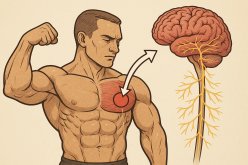
Mind-muscle connection: the key to effective training
Muscle gain
Recommended by our experts
Receive your personalized program
Stop training at random.
Get my program- Program tailored to your profile
- Guided progression
- Compatible with your equipment
- Structured plan
Our coach prepares your program
Get my program