Legless Rope Climb
Demonstration video

Recommended by our experts
Receive your personalized program
Stop training at random.
Get my program- Program tailored to your profile
- Guided progression
- Compatible with your equipment
- Structured plan
Our coach prepares your program
Get my programHow to do Legless Rope Climb
Instructions
- Start in a hanging position beneath the rope with arms extended and legs off the ground.
- Engage your back and arms to pull your body upward, hand over hand.
- Keep your legs straight and together throughout the climb to maintain strict form.
- Continue climbing until reaching the designated height or endpoint.
- Descend under control, maintaining engagement in your arms and core.
Technical Tips
- Use a strong grip and pull explosively while keeping the rope close to your body.
- Maintain a tight hollow-body position to prevent swinging.
- Avoid using your legs for support to ensure upper-body isolation.
Breathing Tips
- Inhale before initiating the pull.
- Exhale briefly at the top of each pull phase.
- Maintain controlled breathing to stabilize core tension throughout the climb.
Medical restrictions
- Shoulder instability or rotator cuff injuries
- Elbow tendinitis or wrist strain
- Grip strength limitations or hand injuries
- Vertigo or height-related anxiety
Description
The Legless Rope Climb is an advanced bodyweight exercise that develops upper body strength, grip endurance, and core control. Unlike traditional rope climbs, this variation eliminates lower body assistance, forcing the arms, shoulders, and back to work in unison to elevate the body. The movement demands coordination, powerful pulling mechanics, and midline stability, making it a staple in CrossFit, obstacle course racing, and elite fitness programs. Because the legs are not used for support, athletes must rely entirely on upper-body pulling strength and efficient climbing technique. The Legless Rope Climb also enhances grip resilience and neuromuscular coordination, especially under fatigue. It is an effective way to assess and build raw pulling power, spatial awareness, and mental fortitude. Given its difficulty, this exercise is best suited for well-trained individuals capable of strict pull-ups and advanced core stabilization.
Frequently asked questions
-
What muscles does the Legless Rope Climb work?
It primarily targets the biceps and back, with strong secondary activation in the forearms, traps, and core for grip, pulling, and body stabilization. -
Is the Legless Rope Climb suitable for beginners?
No, it's an advanced movement requiring significant upper-body strength and core control. Beginners should first build strength through pull-ups and rope holds. -
How can I improve at Legless Rope Climbs?
Progress by training strict pull-ups, towel pulls, rope hangs, and core strengthening exercises to develop the grip and pulling power needed. -
How high should I climb during a Legless Rope Climb?
Standard heights range from 12 to 15 feet, but it should be adjusted based on skill level and facility safety standards. -
Is descending the rope part of the workout?
Yes, controlled descents improve eccentric strength and reduce injury risk. Always descend with awareness and core engagement.
Variants and alternatives
See all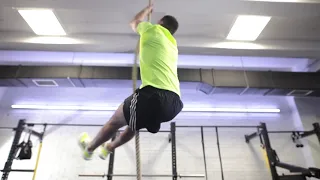
Related fitness articles
See all
Shoulder pain in weight training: prevention and solutions
Risk of injuries

What is the best training structure?
Muscle gain

Lose weight fast: effective and safe methods
Diet

Dietary supplements: what should you know?
Health

Cardio and strength training: how to avoid interference
Weight loss

Supplements taken wrong: mistakes that cancel their effects
Dietary supplements

High-calorie foods: why choose them?
Muscle gain

Mind-muscle connection: the key to effective training
Muscle gain
Recommended by our experts
Receive your personalized program
Stop training at random.
Get my program- Program tailored to your profile
- Guided progression
- Compatible with your equipment
- Structured plan
Our coach prepares your program
Get my program