Dumbbell Superman
Demonstration video
Recommended by our experts
Receive your personalized program
Stop training at random.
Get my program- Program tailored to your profile
- Guided progression
- Compatible with your equipment
- Structured plan
Our coach prepares your program
Get my programHow to do Dumbbell Superman
Instructions
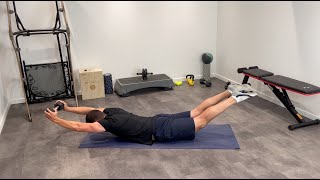
- Lie face down on a yoga mat with arms extended forward holding a dumbbell with both hands.
- Keep legs straight and together, fully extended behind you.
- Engage your core and glutes, then lift your arms, chest, and legs off the ground simultaneously.
- Hold the top position briefly, focusing on squeezing your glutes and lower back.
- Lower back down with control and repeat for time.
Technical Tips
- Keep your head in a neutral position aligned with your spine.
- Do not overextend your lower back; focus on muscle engagement, not height.
- Use a lightweight dumbbell to maintain proper form.
Breathing Tips
- Inhale while lying flat before initiating the movement.
- Exhale as you lift into the Superman position.
- Inhale again as you return to the starting position.
Medical restrictions
- Lower back injuries
- Herniated disc
- Sciatica
- Shoulder impingement
Description
The Dumbbell Superman is an effective bodyweight-based strengthening exercise that enhances posterior chain engagement with added resistance. Performed lying face down, it involves lifting both arms and legs simultaneously while holding a dumbbell, creating an isometric contraction through the lower back, glutes, and shoulders. This movement is ideal for improving postural alignment, enhancing spinal stability, and preventing lower back discomfort often caused by sedentary lifestyles. Adding a dumbbell intensifies the muscular demand, particularly across the upper back and rear deltoids. Suitable for intermediate-level individuals, this movement develops strength endurance and body control without the need for complex equipment. The Dumbbell Superman fits seamlessly into core or back-focused routines and is commonly used in rehabilitation and general fitness programs for its low-impact nature. Practitioners looking to counterbalance anterior chain dominance (from sitting or front-loaded training) will benefit significantly from incorporating this exercise into their regimen. When performed consistently with proper form, it supports joint health and postural resilience over time.
Frequently asked questions
-
What muscles does the Dumbbell Superman work?
The Dumbbell Superman primarily targets the lower back and glutes, while also engaging the lats, rear deltoids, and rhomboids for full posterior chain activation. -
Is the Dumbbell Superman good for lower back pain?
Yes, when performed with proper form and no existing injury, the Dumbbell Superman can strengthen the lower back muscles, helping reduce the risk of future pain and improve spinal stability. -
How long should I hold the Dumbbell Superman position?
Beginners should start with 10–15 seconds per hold, gradually increasing to 30–45 seconds as strength and endurance improve. -
Can I do the Dumbbell Superman without weights?
Yes, the bodyweight version is a great alternative and often recommended for beginners or for warming up before weighted variations. -
Is the Dumbbell Superman suitable for beginners?
The weighted version is best for intermediates, but beginners can start with the bodyweight version to build foundational strength safely.
Variants and alternatives
See all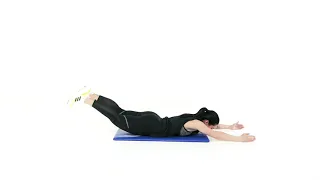
Related fitness articles
See all
Shoulder pain in weight training: prevention and solutions
Risk of injuries

What is the best training structure?
Muscle gain

Lose weight fast: effective and safe methods
Diet

Dietary supplements: what should you know?
Health

Cardio and strength training: how to avoid interference
Weight loss

Supplements taken wrong: mistakes that cancel their effects
Dietary supplements

High-calorie foods: why choose them?
Muscle gain
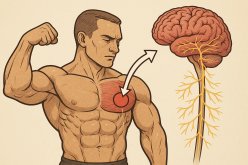
Mind-muscle connection: the key to effective training
Muscle gain
Recommended by our experts
Receive your personalized program
Stop training at random.
Get my program- Program tailored to your profile
- Guided progression
- Compatible with your equipment
- Structured plan
Our coach prepares your program
Get my program