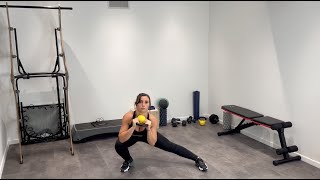
Kettlebell Goblet Lateral Lunge
Demonstration video
Recommended by our experts
Receive your personalized program
Stop training at random.
Get my program- Program tailored to your profile
- Guided progression
- Compatible with your equipment
- Structured plan
Our coach prepares your program
Get my programHow to do Kettlebell Goblet Lateral Lunge
Instructions
- Stand tall holding a kettlebell with both hands close to your chest in goblet position.
- Step one leg laterally to the side, keeping the other leg extended.
- Bend the lead knee and push your hips back while keeping the chest upright.
- Lower until your thigh is parallel to the ground, then push through the foot to return to the starting position.
- Repeat on the same side or alternate legs as required.
Technical Tips
- Keep the kettlebell close to your chest to maintain balance and core engagement.
- Do not allow your knee to cave inward during the lunge.
- Maintain a neutral spine and avoid leaning forward.
- Ensure your trailing leg remains straight and toes point forward.
Breathing Tips
- Inhale as you step out and lower into the lunge.
- Exhale as you push through the foot to return to the starting position.
Medical restrictions
- Knee injuries or instability
- Hip mobility limitations
- Lower back pain or spinal disc issues
Description
The Kettlebell Goblet Lateral Lunge is an effective lower body strength and mobility exercise that combines unilateral leg work with core engagement. By holding the kettlebell in a goblet position, this movement encourages proper posture and increases upper body involvement, especially in stabilizing the spine. It is a powerful tool for developing strength in the quadriceps, glutes, and adductors, while also improving balance, coordination, and lateral movement control. The lateral motion challenges underused muscle groups not typically engaged in forward-backward movements, making it highly valuable for athletic training and functional fitness. This exercise also helps to address imbalances between legs and promotes hip and ankle mobility. Ideal for intermediate to advanced fitness levels, it can be integrated into strength training routines, functional circuits, or mobility-focused sessions.
Frequently asked questions
-
What muscles do I work with the kettlebell goblet lateral lunge?
The kettlebell goblet lateral lunge primarily targets your quadriceps, glutes, and adductors, while also engaging your core and hip stabilizers for balance and control. -
Is the kettlebell goblet lateral lunge good for beginners?
While it's best suited for intermediate users due to balance and mobility demands, beginners can start with a bodyweight version before progressing to the kettlebell goblet lateral lunge. -
Can I replace squats with lateral lunges for leg development?
Lateral lunges complement squats by targeting different planes of motion and muscle groups, particularly the adductors and glute medius, but should not completely replace squats in a balanced program. -
How heavy should my kettlebell be for lateral lunges?
Choose a kettlebell weight that allows you to maintain proper form and complete 8–12 reps per leg with controlled movement; typically, moderate loads are best for this exercise.
Variants and alternatives
See all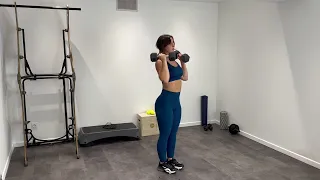
Dumbbell overhead reverse lunge
Intermediate
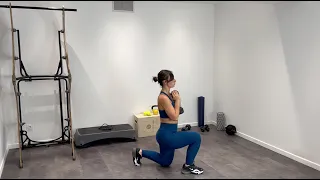
Goblet front lunge
Beginner
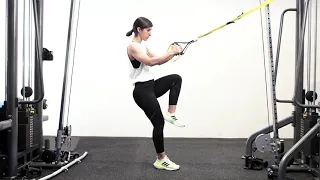
Trx crossing balance lunge
Intermediate
Single kettlebell reverse lunge
Intermediate
Dumbbell walking lunge
Intermediate
Dumbbell goblet lunge walk
Intermediate
Single-arm dumbbell overhead lunge
Intermediate
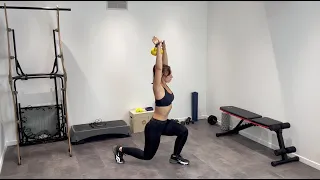
Kettlebell overhead pulse lunge
Advanced
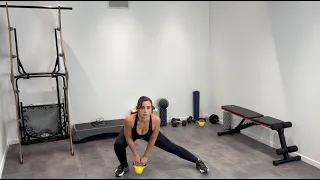
Kettlebell lateral lunge
Intermediate
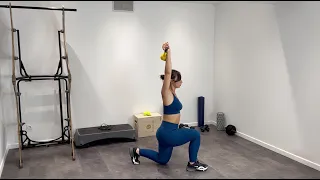
Kettlebell single arm overhead reverse lunge
Advanced
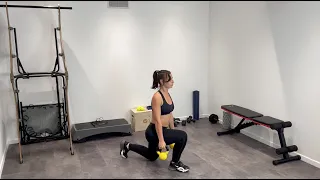
Kettlebell reverse lunge
Intermediate
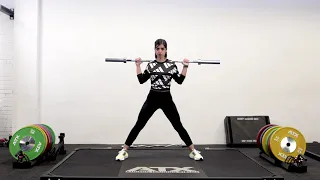
Barbell lateral lunge
Intermediate
Related fitness articles
See all
Shoulder pain in weight training: prevention and solutions
Risk of injuries
What is the best training structure?
Muscle gain
Lose weight fast: effective and safe methods
Diet

Dietary supplements: what should you know?
Health

Cardio and strength training: how to avoid interference
Weight loss
Supplements taken wrong: mistakes that cancel their effects
Dietary supplements
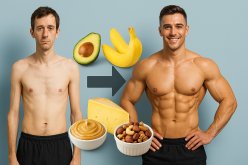
High-calorie foods: why choose them?
Muscle gain
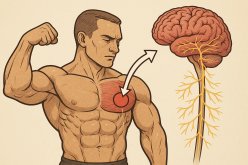
Mind-muscle connection: the key to effective training
Muscle gain
Recommended by our experts
Receive your personalized program
Stop training at random.
Get my program- Program tailored to your profile
- Guided progression
- Compatible with your equipment
- Structured plan
Our coach prepares your program
Get my program