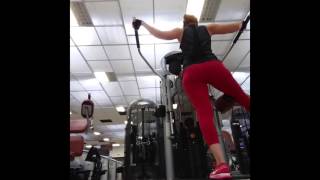
Standing Machine Adduction
Demonstration video
Recommended by our experts
Receive your personalized program
Stop training at random.
Get my program- Program tailored to your profile
- Guided progression
- Compatible with your equipment
- Structured plan
Our coach prepares your program
Get my programHow to do Standing Machine Adduction
Instructions
- Stand next to the machine and attach the ankle strap to the working leg.
- Hold the support handles or frame for balance.
- Start with your leg abducted outward, then slowly bring it inward across your body against resistance.
- Pause briefly at the end of the range of motion.
- Return slowly to the starting position with control.
Technical Tips
- Keep your torso upright and avoid leaning to the side.
- Engage your core to stabilize the movement.
- Avoid using momentum; prioritize slow, controlled movement.
- Ensure full range of motion without overextending.
Breathing Tips
- Exhale as you bring the leg inward against resistance.
- Inhale as you return to the starting position.
Medical restrictions
- Hip impingement
- Groin strain or injury
- Severe balance disorders
Description
The Standing Machine Adduction is a lower-body isolation exercise designed to strengthen and tone the inner thigh muscles, particularly the hip adductors. Unlike its seated counterpart, this variation is performed in a standing position, enhancing balance, core engagement, and unilateral control. The guided machine provides stability while allowing the user to execute the movement with a fixed range of motion, ensuring proper alignment and reducing the risk of injury.
This exercise is especially beneficial for athletes and fitness enthusiasts aiming to improve hip stability, leg coordination, and muscle symmetry. It also serves as a valuable addition to rehabilitation programs targeting hip or groin strength deficits. Due to its guided nature and low skill requirement, it is suitable for beginners, yet still offers progressive overload for more advanced users through increased resistance.
Incorporating the Standing Machine Adduction into a well-rounded leg day routine can help correct muscle imbalances, support pelvic alignment, and enhance overall functional performance. It’s a practical and effective way to target a commonly neglected muscle group with precision and safety.
Frequently asked questions
-
What muscles do standing machine adductions work?
Standing machine adductions primarily target the adductors, the inner thigh muscles responsible for bringing the legs together. They also activate the gluteus medius and other stabilizers during the movement. -
Is standing machine adduction good for inner thighs?
Yes, standing machine adduction is highly effective for strengthening and toning the inner thighs, making it a valuable addition to lower-body workouts focused on leg definition and hip stability. -
Can beginners do standing machine adduction safely?
Absolutely. The standing machine adduction is beginner-friendly due to its guided movement and adjustable resistance, making it safe and easy to learn while promoting inner thigh strength and control. -
What is the difference between seated and standing adduction machines?
The seated adduction machine offers more support and isolates the adductors, while the standing version engages additional stabilizing muscles like the glutes and core, enhancing balance and functional strength.
Related fitness articles
See all
Shoulder pain in weight training: prevention and solutions
Risk of injuries
What is the best training structure?
Muscle gain

Lose weight fast: effective and safe methods
Diet

Dietary supplements: what should you know?
Health
Cardio and strength training: how to avoid interference
Weight loss
Supplements taken wrong: mistakes that cancel their effects
Dietary supplements

High-calorie foods: why choose them?
Muscle gain
Mind-muscle connection: the key to effective training
Muscle gain
Recommended by our experts
Receive your personalized program
Stop training at random.
Get my program- Program tailored to your profile
- Guided progression
- Compatible with your equipment
- Structured plan
Our coach prepares your program
Get my program