Copenhagen Plank
Demonstration video

Recommended by our experts
Receive your personalized program
Stop training at random.
Get my program- Program tailored to your profile
- Guided progression
- Compatible with your equipment
- Structured plan
Our coach prepares your program
Get my programHow to do Copenhagen Plank
Instructions
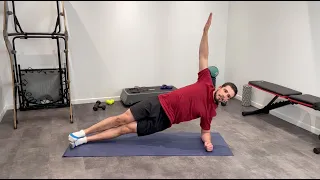
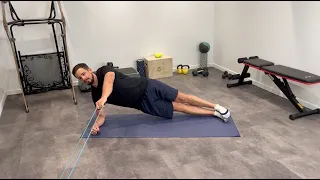
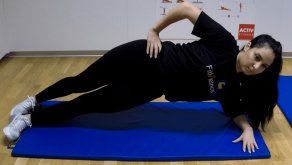
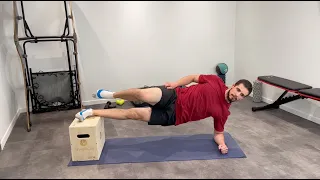
- Lie on your side with your upper foot placed on a plyobox and your elbow directly under your shoulder.
- Lift your hips off the ground to align your body from head to foot.
- Engage your core and adductors to maintain the position.
- Hold the position for the desired duration.
- Lower your hips back down with control to complete the set.
Technical Tips
- Keep your body in a straight line throughout the hold.
- Avoid letting your hips sag or rotate forward/backward.
- Keep your neck neutral and gaze forward.
- Ensure the supporting elbow is aligned directly under the shoulder.
Breathing Tips
- Inhale before lifting your hips.
- Exhale steadily while holding the position.
- Maintain controlled breathing throughout the hold.
Medical restrictions
- Hip adductor strain
- Shoulder instability
- Lower back injury
- Inguinal hernia
Description
The Foot Elevated Adductor Side Plank, also known as the Copenhagen Plank, is a powerful bodyweight exercise designed to strengthen the inner thigh muscles and improve lateral core stability. By elevating the top leg on a stable surface like a plyobox, this movement emphasizes isometric tension in the adductors while simultaneously engaging the obliques, glutes, and stabilizing shoulder muscles. This exercise is commonly used in athletic training and rehabilitation to prevent groin injuries and enhance pelvic control. It challenges balance, unilateral strength, and trunk stability, making it particularly beneficial for sports that involve cutting, sprinting, or rapid lateral movement. Because of its high muscular demand, it is considered an advanced movement and should be performed with strict form to avoid compensation and potential injury. The Copenhagen Plank is especially valued in strength and conditioning programs for its role in injury prevention and functional performance gains.
Frequently asked questions
-
What muscles does the Copenhagen plank target the most?
The Copenhagen plank primarily targets the adductors, especially the inner thigh of the lower leg, while also working the obliques, glutes, and shoulder stabilizers for core and hip stability. -
Is the foot elevated adductor plank good for groin injury prevention?
Yes, the foot elevated adductor plank is highly effective for groin injury prevention as it strengthens the adductors, improves pelvic control, and enhances core stability, all of which reduce injury risk during athletic movements. -
Can I do the Copenhagen plank if I have lower back pain?
If you have lower back pain, it's important to consult a medical professional before attempting the Copenhagen plank, as the core and hip demands may aggravate existing conditions if not properly executed. -
How long should I hold the foot elevated adductor side plank?
Beginners can start with 10–20 seconds per side and progressively increase to 30–60 seconds as strength and stability improve, maintaining perfect form throughout. -
What is the difference between the Copenhagen plank and a regular side plank?
The Copenhagen plank includes active engagement of the adductors by elevating one leg, offering a greater challenge to inner thigh muscles compared to a regular side plank, which primarily targets the obliques.
Related fitness articles
See all
Shoulder pain in weight training: prevention and solutions
Risk of injuries
What is the best training structure?
Muscle gain
Lose weight fast: effective and safe methods
Diet

Dietary supplements: what should you know?
Health
Cardio and strength training: how to avoid interference
Weight loss
Supplements taken wrong: mistakes that cancel their effects
Dietary supplements

High-calorie foods: why choose them?
Muscle gain
Mind-muscle connection: the key to effective training
Muscle gain
Recommended by our experts
Receive your personalized program
Stop training at random.
Get my program- Program tailored to your profile
- Guided progression
- Compatible with your equipment
- Structured plan
Our coach prepares your program
Get my program