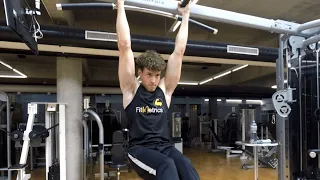
Hanging straight leg raise
Demonstration video
Recommended by our experts
Receive your personalized program
Stop training at random.
Get my program- Program tailored to your profile
- Guided progression
- Compatible with your equipment
- Structured plan
Our coach prepares your program
Get my programHow to do Hanging straight leg raise
Instructions
- Hang from a pull-up bar with arms fully extended and legs straight.
- Engage your core and lift both legs upward while keeping them straight.
- Raise legs to at least parallel to the ground or higher if possible.
- Pause briefly at the top of the movement.
- Lower your legs slowly under control back to the starting position.
Technical Tips
- Avoid using momentum; perform the movement slowly and under control.
- Keep your shoulders active and avoid shrugging.
- Maintain straight legs throughout the motion for maximal abdominal engagement.
- Do not swing your torso; keep your body stable.
Breathing Tips
- Exhale while lifting your legs.
- Inhale slowly as you lower your legs back down.
Medical restrictions
- Lower back pain or herniated disc
- Shoulder impingement or instability
- Hip flexor tendinitis
- Post-abdominal surgery recovery
Description
The hanging straight leg raise is a powerful core strengthening exercise commonly used in calisthenics, bodybuilding, and fitness training programs. Performed while hanging from a pull-up bar, this movement emphasizes strict abdominal engagement and requires significant control and flexibility. It is particularly effective at developing the lower portion of the rectus abdominis and improving core stability and control. Unlike easier variations such as the knee raise, this exercise demands strong hip flexor activation and grip endurance. Additionally, it contributes to enhanced mobility and strength in the hip flexors and helps improve overall athletic performance. Ideal for advanced practitioners, the hanging straight leg raise also supports posture correction by engaging deep stabilizing muscles in the trunk. Incorporating it into a regular workout routine builds a solid and functional midsection while reducing the risk of core-related weaknesses or injuries.
Credits

Frequently asked questions
-
What muscles do hanging straight leg raises work?
Hanging straight leg raises primarily work the abdominal muscles, especially the lower abs, while also engaging the hip flexors, forearms, and stabilizing muscles in the back and shoulders. -
How do I avoid swinging during hanging leg raises?
To avoid swinging during hanging leg raises, engage your core tightly, initiate movement slowly, and avoid using momentum. Keeping your legs straight and lifting with control also helps reduce body sway. -
Are hanging leg raises good for building abs?
Yes, hanging leg raises are highly effective for building strong and defined abs, especially the lower abdominal region, due to the full range of motion and intense core engagement required. -
Is this exercise safe for lower back pain?
Hanging straight leg raises are not recommended for individuals with lower back pain or disc issues, as the hip flexor activation and lumbar strain may aggravate symptoms. Consult a healthcare professional before attempting. -
How many reps of hanging straight leg raises should I do?
For strength and muscle development, aim for 3–4 sets of 8–12 controlled repetitions. Adjust volume based on your experience and core endurance.


Related fitness articles
See all
Shoulder pain in weight training: prevention and solutions
Risk of injuries
What is the best training structure?
Muscle gain

Lose weight fast: effective and safe methods
Diet

Dietary supplements: what should you know?
Health

Cardio and strength training: how to avoid interference
Weight loss

Supplements taken wrong: mistakes that cancel their effects
Dietary supplements

High-calorie foods: why choose them?
Muscle gain

Mind-muscle connection: the key to effective training
Muscle gain
Recommended by our experts
Receive your personalized program
Stop training at random.
Get my program- Program tailored to your profile
- Guided progression
- Compatible with your equipment
- Structured plan
Our coach prepares your program
Get my program